

B.Sc Agriculture (Honours)
Agriculture is the world’s oldest profession and its most urgent frontier. The B.Sc. Agriculture (Honours) programme at the Doon School of Modern Agriculture & Forestry is designed for students
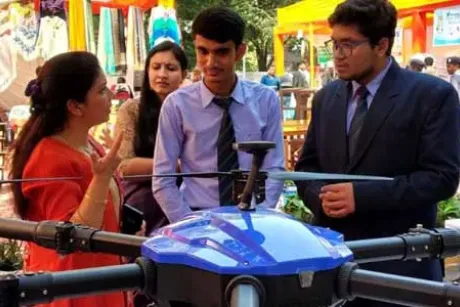
who aspire to stand at that frontier — equipped with the science to understand it and the skill to advance it. Over four immersive years, students explore the full spectrum of modern farming: soil health and crop physiology, pest management, watershed science, agribusiness, and the precision technologies reshaping how humanity grows food.
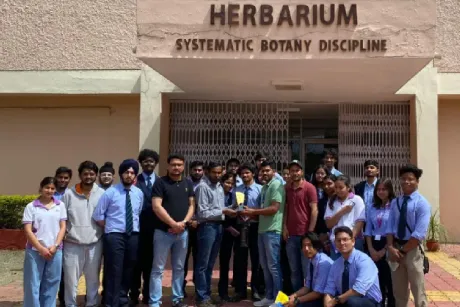
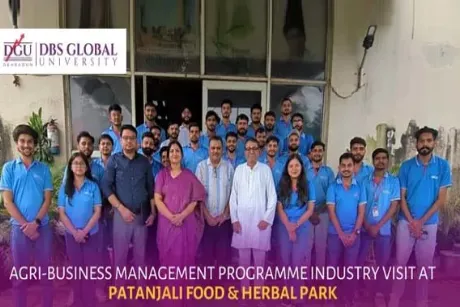
What distinguishes this programme from a conventional degree is its commitment to making knowledge actionable. ICAR-aligned coursework meets national standards, while dedicated farmland, poly-houses, and protected cultivation units ensure that every concept studied is also touched, tested, and seen yield results. Structured visits to GBPUAT Pantnagar, FRI, ZSI, IMD, and CAP extend the laboratory into India’s finest scientific institutions and agricultural research ecosystems.
Students benefit from DBS Global University’s vibrant, multi-disciplinary environment. Studying alongside peers from engineering, business, and law fosters the interdisciplinary mindset that modern agriculture demands. Integrated coaching for UPSC, ICAR, IFS, and agri-finance examinations, combined with placement support from 350+ campus recruiters and 22+ active student clubs, ensures that graduates leave not only with a degree but with a clear direction.
USPs of the Program
Advantage @DGU
Choosing a university is one of the most important decisions in a student’s life — and at DBS Global University, that decision is treated as far more than a brochure promise. The Advantage @DGU is the institution’s commitment: a learning environment so complete, so well-positioned, and so purposefully designed that the years spent here do not simply prepare students for a career — they set the trajectory of one.
From the moment students arrive in Dehradun to the day they walk across the stage, every element of DBS Global University — the city, the campus, the curriculum, the industry connections, and the community — works in their favour. This is what the Advantage @DGU looks like in practice.
350+
Campus Recruiters Every Year
23
States Represented on Campus
20+
Countries for Global Exposure
5
Countries — International Students
Career Opportunities
Government Sector Careers
Private Sector Roles
Higher Education & Research
Entrepreneurship & Allied Fields
Emerging & High-Paying Roles
Course Structure
Programme Duration: 4 Years (8 Semesters) | Total Credits: 166 | As per NEP 2020 & OBE Framework
| Course Type Legend | |||
|---|---|---|---|
| CC | Core Course | VAC | Value Added Course |
| AEC | Ability Enhancement Course | SEC | Skill Enhancement Course |
| OE | Open Elective | MDE | Multi Disciplinary Elective |
| GP | General Proficiency | ||
| Credits: 1 Lecture hr = 1 credit, 2 Practical hrs = 1 credit | GP = General Proficiency | |||
| Year 1 (Semester I) | Year 1 (Semester II) | ||||||
|---|---|---|---|---|---|---|---|
| S.No. | Subject | Type | Credits | S.No. | Subject | Type | Credits |
| 1 | Farming-based Livelihood Systems | CC | 3 | 1 | Fundamentals of Crop Physiology | CC | 3 |
| 2 | Principles of Genetics | CC | 3 | 2 | Essentials of Biochemistry | CC | 3 |
| 3 | Fundamentals of Agronomy | CC | 3 | 3 | Basics of Plant Breeding | CC | 3 |
| 4 | Fundamentals of Entomology | CC | 3 | 4 | Fundamentals of Horticulture | CC | 3 |
| 5 | Weed Management | CC | 2 | 5 | Fundamentals of Nematology | CC | 2 |
| 6 | Environmental Science & Sustainability | VAC | 2 | 6 | Indian Constitution | VAC | 2 |
| 7 | General English | AEC | 2 | 7 | Communication Skills | AEC | 3 |
| 8 | Advanced Spreadsheets | SEC | 2 | 8 | Basics and Applied Statistics | SEC | 2 |
| 9 | GP-1 (General Proficiency) | GP | 1 | 9 | Open Elective – 1 | OE | 2 |
| GP-2 (General Proficiency) | GP | 1 | |||||
| TOTAL | 21 | TOTAL | 24 | ||||
| Year 2 (Semester III) | Year 2 (Semester IV) | ||||||
| S.No. | Subject | Type | Credits | S.No. | Subject | Type | Credits |
| 1 | Fundamentals of Soil Science & Fertility Management | CC | 3 | 1 | Remote Sensing & GIS Application | CC | 2 |
| 2 | Fundamentals of Agricultural Biotechnology | CC | 3 | 2 | Pest Management in Crops & Stored Grains | CC | 3 |
| 3 | Crop Production Technology & Improvement (Kharif Crops) | CC | 4 | 3 | Crop Production Technology & Improvement (Rabi Crops) | CC | 4 |
| 4 | Production Technology of Fruits, Vegetables & Plantation Crops | CC | 3 | 4 | Production Technology for Ornamental Crops, Spices, MAP & Landscaping | CC | 3 |
| 5 | Indian Knowledge System (Yoga / Sports / NCC / NSS / Disaster Management) | VAC | 2 | 5 | Problematic Soils & Their Management | CC | 3 |
| 6 | QT & Logical Reasoning – I | AEC | 2 | 6 | Design Thinking & Innovation | VAC | 2 |
| 7 | Social Internship | SEC | 4 | 7 | QT & Logical Reasoning – II | AEC | 2 |
| 8 | Agri Business Management | MDE | 2 | 8 | Entrepreneurship Development & Business Management | SEC | 2 |
| 9 | GP-3 (General Proficiency) | GP | 1 | 9 | Open Elective – 2 | OE | 2 |
| 10 | GP-4 (General Proficiency) | GP | 1 | ||||
| TOTAL | 24 | TOTAL | 24 | ||||
| Year 3 (Semester V) | Year 2 (Semester VI) | ||||||
| S.No. | Subject | Type | Credits | S.No. | Subject | Type | Credits |
| 1 | Introduction to Agrometeorology | CC | 3 | 1 | Agroforestry Systems & Management | CC | 2 |
| 2 | Fundamentals of Plant Pathology | CC | 3 | 2 | Agriculture Finance & Corporation | CC | 2 |
| 3 | Livestock & Poultry Management | CC | 3 | 3 | Farm Machinery & Power | CC | 2 |
| 4 | Diseases of Field & Horticultural Crops & Their Management | CC | 3 | 4 | Water Management | CC | 2 |
| 5 | Introduction to ESG Principles | VAC | 2 | 5 | Agriculture Microbiology & Phytoremediation | CC | 2 |
| 6 | Personality Development | AEC | 3 | 6 | Food Safety & Standards | VAC | 2 |
| 7 | Internship / Capstone Project | SEC | 4 | 7 | Agricultural Informatics & Artificial Intelligence | SEC | 2 |
| 8 | Agricultural Marketing & Trade | MDE | 2 | ||||
| 9 | GP-5 (General Proficiency) | GP | 1 | ||||
| TOTAL | 24 | TOTAL | 14 | ||||
| Year 4 (Semester VII ) Honours | Year 4 (Semester VIII) Honours | ||||||
| S.No. | Subject | Type | Credits | S.No. | Subject | Type | Credits |
| 1 | *RAWE — Rural Agricultural Work Experience & Agro-industrial Attachment | CC | 8 | 1 | Dryland Agriculture / Rainfed Agriculture & Watershed Management | CC | 3 |
| 2 | Rural Sociology & Extension Education | CC | 3 | 2 | Fundamentals of Seed Science & Technology | CC | 3 |
| 3 | Principles of Agricultural Economics & Farm Management | CC | 2 | 3 | Elective I (from Elective Course List) | CC | 3 |
| 4 | Professional Ethics | VAC | 2 | 4 | Elective II (from Elective Course List) | CC | 3 |
| 5 | Public Relations Internship | SEC | 6 | 5 | Introduction to ESG Principles | VAC | 2 |
| TOTAL | 21 | TOTAL | 14 | ||||
| *RAWE: Students are placed at agricultural stations, KVKs, agro-industries, and farms for hands-on immersive training. | |||||||
Elective Course List (Choose 2 in Semester VIII)
| S.No. | Elective Courses — Choose any 2 (3 credits each) | Credits |
|---|---|---|
| 1 | Management of Natural Resources | 3 |
| 2 | Agrochemicals | 3 |
| 3 | Agricultural Journalism | 3 |
| 4 | Landscaping | 3 |
| 5 | Commercial Plant Breeding | 3 |
| 6 | Bioformulation and Nanoformulation | 3 |
| 7 | Biopesticides and Biofertilizers | 3 |
| 8 | System Simulation and Agro-Advisory | 3 |
| 9 | Hi-tech Horticulture | 3 |
| 10 | Protected Cultivation | 3 |
| 11 | Climate Resilient Agriculture | 3 |
| 12 | Micro-propagation Technologies | 3 |
| 13 | Commercial Seed Production | 3 |
| 14 | Principles & Practices of Organic Farming / Conservation Agriculture | 3 |
| 15 | Food Science and Nutrition | 3 |
Minor Discipline Electives(MDE) - Offered in Semesters III & V
| S.No. | MDE Courses (6 Credits total across programme) | Credits |
|---|---|---|
| 1 | Agri Business Management (Semester III) | 2 |
| 2 | Agricultural Marketing &Trade (Semester V) | 2 |
| 3 | MDE – III (To be offered as applicable) | 2 |
Open Electives(OE) - Offered in Semesters II & IV
| S.No. | Open Elective Courses (4 Credits total — 2 credits each) | Credits |
|---|---|---|
| 1 | Open Elective – 1 (Semester II) | Any interdisciplinary elective from University pool | 2 |
| 2 | Open Elective – 2 (Semester IV) | Any interdisciplinary elective from University pool | 2 |
Programme Credit Summary
| Code | Category | Credits | No. of Subjects |
|---|---|---|---|
| CC | Core Courses | 99 | 31 |
| VAC | Value Added Courses | 16 | 8 |
| AEC | Ability Enhancement Courses | 12 | 5 |
| SEC | Skill Enhancement Courses | 24 | 7 |
| OE | Open Electives | 4 | 2 |
| MDE | Minor Discipline Electives | 6 | 3 |
| GP | General Proficiency | 5 | 5 |
| TOTAL | 166 | 61 | |
| Semester-wise Credit Distribution: I (21) + II (24) + III (24) + IV (24) + V (24) + VI (14) + VII (21) + VIII (14) =166 Credits | |||
Credit Definition
| Activity | Credits |
|---|---|
| 1 hour Lecture per week | 1 Credit |
| 1 hour Tutorial per week | 1 Credit |
| 2 hours Practical per week | 1 Credit |
Fee Structure
B.Sc. Agriculture 2026-30
| Fees | I Semester | II Semester | III Semester | IV Semester | V Semester | VI Semester | VII Semester | VIII Semester |
|---|---|---|---|---|---|---|---|---|
| Admission Fee | 10,000 | |||||||
| Tution Fee | 55,000 | 55,000 | 57,000 | 57,000 | 59,000 | 59,000 | 61,000 | 61,000 |
| Special Diversity Scholarship 25% (-) | 13,750 | 13,750 | 14,250 | 14,250 | 14,750 | 14,750 | 15,250 | 15,250 |
| Total | 51,250 | 41,250 | 42,750 | 42,750 | 44,250 | 44,250 | 45,750 | 45,750 |
| Security (Refundable) | - | - | 10,000 | - | - | - | - | - |
| Other Incidental Compulsory Charges | ||||||||
| Charges for Uniform (Dress Camp) | 9,500 | - | - | - | - | - | ||
| Book Bank (EET Library) | 4,500 | - | - | - | - | - | - | - |
| Career Development Cell Membership | - | - | - | - | - | - | 7,500 | - |
| Alumni Registration + 1 Year Enrollment | - | - | - | - | - | - | - | 5,000 |
| University Examination Fees | 5,500 | 5,500 | 5,500 | 5,500 | 5,500 | 5,500 | 5,500 | 5,500 |
*Special Diversity Scholarship 2026 25% of the tuition fee | Uttarakhand Domicile Scholarship of 25% | Ward of Single Mother | Ward of Defence Personal | Ward of Full Time Teacher.
*In cases where a student is eligible for a higher merit-based scholarship under the same program, only the scholarship with the higher benefit shall be applicable.
*Under no circumstances shall two scholarships be clubbed or combined simultaneously.
*Online ERP Fee Rs. 1000 per semester
Fee is subject to change. For updated fee structure kindly visit www.doonbusinessschool.com / www.dgu.ac.in
Scholarship
Scholarships for Undergraduate Students for 2026 intake
| CATEGORY | 10% | 20% | 30% | 40% | 50% Waiver |
|---|---|---|---|---|---|
| 12th% (Central) | 80.00-84.9 | 85.00-89.9 | 90.00-92.5 | 92.60-94.9 | 95.00+ |
| JEE / CUET %tile | 75-79.9 | 80 - 84.9 | 85 - 89.9 | 90 - 94.9 | 95.00+ |
| NEET-UG %tile | 50-59.9 | 60-69.9 | 70-79.9 | 75-79.9 | 80.00+ |
| ICAR AIEEA (Rank) | 5k-8k | 3k-5k | 2k-3k | 1.5k-2k | 1-1500 |
Regional & State Entrance Exams
Includes: UPCATET, MP PAT, KCET, TNAU, EAMCET, KEAM, MHT-CET, & RAJUVAS.
| Exam / Board | 10% | 20% | 30% | 40% | 50% Waiver |
|---|---|---|---|---|---|
| State CETs | 75-79.9 | 80 - 84.9 | 85 - 89.9 | 90-93.9 | 94.00+ |
| Bihar (BCECE) | 70-74.9 | 75-79.9 | 80-84.9 | 85-89.9 | 90.00+ |
| NE Exams1 | 65-69.9 | 70-74.9 | 75-79.9 | 80-84.9 | 85.00+ |
| NE Board (12th %) | 75-79.9 | 80-84.9 | 85-89.9 | 90-92.9 | 93.00+ |
| 1 NE Exams :Covers NECET (AAU Jorhat) and CAU JEE (Imphal). | |||||
Rank-Based (Bihar BUAT)
| CATEGORY | 10% | 20% | 30% | 40% | 50% Waiver |
|---|---|---|---|---|---|
| BUAT Rank | 2k-3k | 1.5k-2k | 1k-1.5k | 701-1k | 1k-700 |
Note : Best 4 Core Subjects only (SUPW, Physical Education and Non-Academic Subjects will not be considered)
Scholarship For Uttarakhand Domicile
25% on Tuition Fee
Note
No two scholarships can be clubbed together; if any student is eligible for two scholarships, they may choose the higher scholarship from the respective category
Procedure
- Students registering for scholarship should apply on the prescribed form avaliable with the institute or on website at the time of interview before confirmation of admission. Students who do not apply before confirmation of admission wlil not be eligible for merit scholarship.
- Students should submit photocopies of all mark sheets and certificates required as above for entitling the scholarship.
- Upon your official confirmation of admission with the DBSG, you wlil receive a formal scholarship offer letter / confirmation.
- The scholarship wlil be disbursed semester wise.
- In case the result of the previous semester has not been declared tlil the last date of submission of fees for the next semester, the student may provisionally submit fees equivalent to the last semester fees but in case falis to get the required marks wlil have to submit the balance fees.
- Whlie applying for a scholarship and fliling in the percentage of class XII marks, applicants are required to consider the aggregate of Best 4 core subjects in their XII boards (SUPW, Physical Education and Non Academic Subjects wlil not be considered).
However the scholarship for 3rd semester onwards wlil be subject to:
In case any of the above criteria is not fulfliled the scholarship for the next semester wlil be withdrawn.
- 75% attendance to be maintained in each subject individually in the preceding semester. Please note that Third Semester Scholarship depends on First semester performance and Fourth semester Scholarship on second semester.
- 70% marks in cumulative score in all subjects.
- Students shall not be involved in any disciplinary action of misconduct where a penalty or fine is imposed by the Proctorial board.
- Students shall take a good moral character certificate from the course coordinator every year and submit the same with the Registrar.
- Students should give an undertaking of being avaliable at all time during the course for any brand ambassador activities and also in case of events/goodwlil programmes.
- There should be no discontinuation in study. In case of transfer to any other institute, the scholarship given wlil have to be refunded prior to issue of College Leaving Certificate.
- Students need to send a thank you letter to the Board of Trustees for the Generous Scholarship every semester.
In case any of the above criteria is not fulfilled, the scholarship for the next semester will be withdrawn.
Disclaimer
Eligibility Criteria
To pursue this program, students must have
Admission Process
Selection is based on a cumulative merit score comprising four components:| Component | Details |
| Class X Marks | Board examination score |
| Class XII Marks | Board examination score (minimum 60% required) |
| National Level Entrance Examination | Any one of the following accepted examinations |
| Online Interview | Conducted by the admissions committee |
| Objective Test | Subject-based aptitude assessment |
Accepted National Level Entrance Examinations
The following examinations are accepted for admission consideration:Merit Calculation
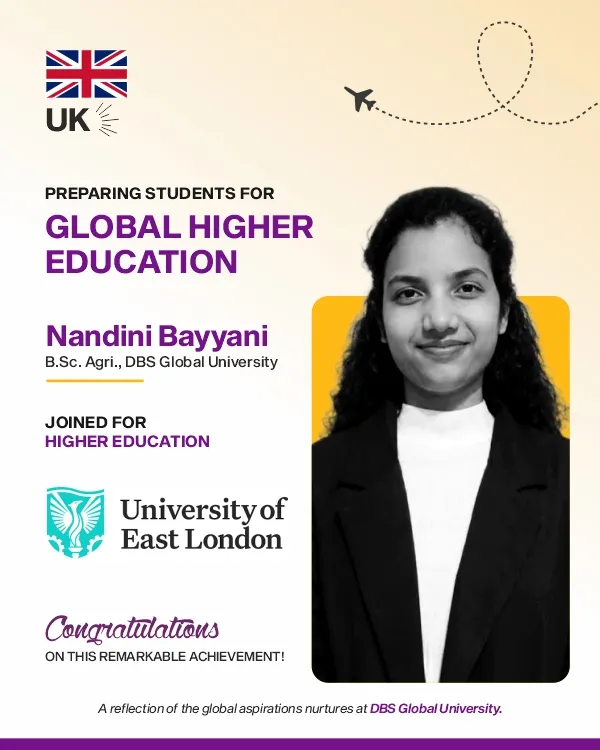
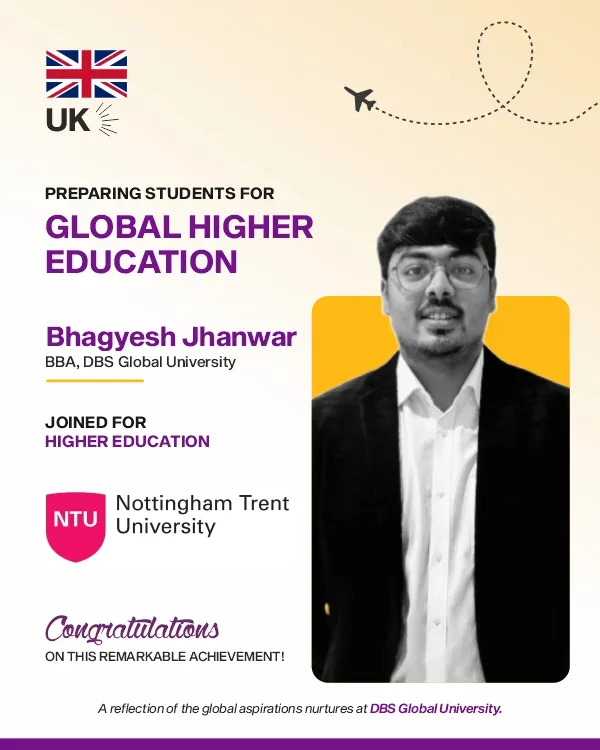
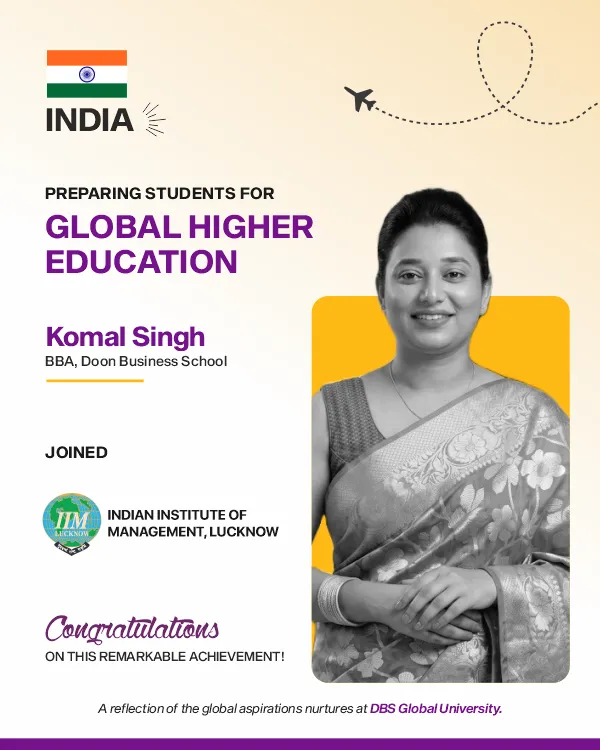
The following examinations are accepted for admission consideration:Career Success in Higher Education
Career Success in Higher Education
























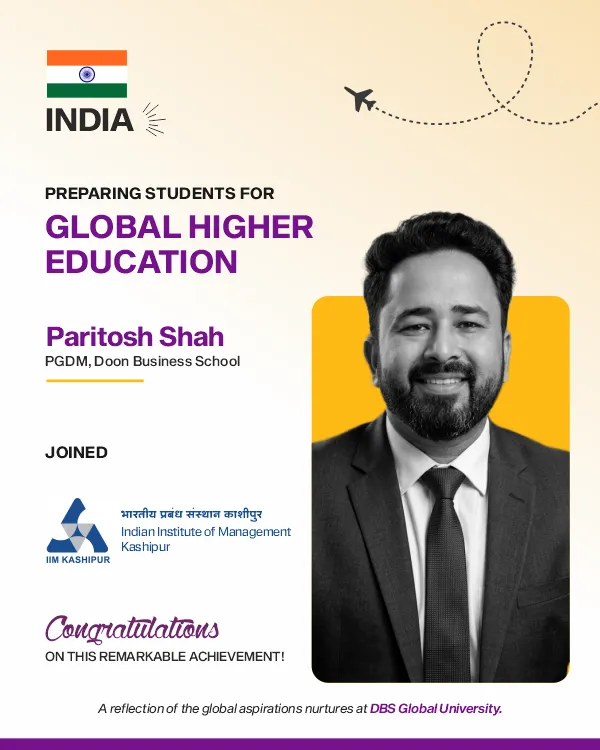

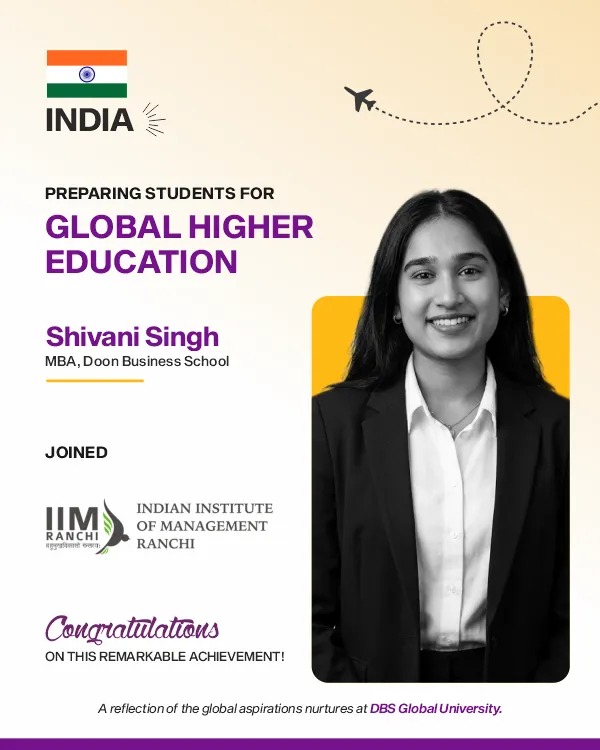

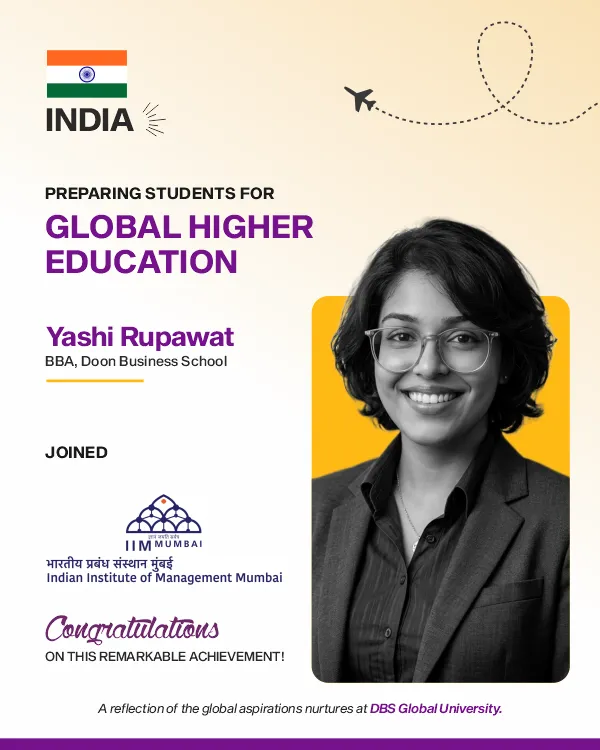
Placements
Enjoy Everyday while Ensuring Great Career




Global Learning & Study Abroad Pathways
International Opportunities for Global Career Readiness
DBS Global University provides students with a wide range of opportunities to gain international exposure and enrich their academic journey through global learning experiences that combine international academics, industry exposure, and cross-cultural engagement. Through a strong network of 50+ academic partnerships across 20+ countries, the University offers multiple international pathways including Global Immersion Programs, Month Mobility Programs, Semester Abroad Programs with Credit Transfer, Articulation and Transfer Programs, Dual Degree Programs, and Global Progression Pathways. In addition to these mobility opportunities, students also benefit from international guest lectures, global masterclasses, academic bootcamps, and international events, delivered in collaboration with partner universities and global industry experts.


Student Testimonials
What our students say about us

Batch : 2021-2025
Current Status : M.Sc Agriculture Extension
Organization : G B Pant University of Agriculture and Technology