

MBA in Healthcare Pharma Management
The Master of Business Administration in Healthcare Management is designed to equip professionals with the skills necessary to excel in the rapidly evolving healthcare sector.
About the Program
The MBA in Healthcare & Pharmaceutical Management offered at the DBS School of Pharmacy and Research under DBS Global University is a two-year postgraduate program designed to develop managerial and leadership skills in the healthcare and pharmaceutical sectors. The program integrates management principles with healthcare industry knowledge, covering areas such as healthcare administration, pharmaceutical marketing, hospital operations, healthcare policies, and strategic management. It prepares students for managerial roles in hospitals, pharmaceutical companies, healthcare organisations, and related sectors.
- Salient Features
- Career Opportunities
- Program Structure
- Fee Structure
- Scholarship
- Eligibility Criteria
- Other Specialization
Salient Features
Career Opportunities
Program Structure
The structure below reflects the MBA framework as shared, with core management courses, communication and employability components, specialization baskets, and SAP / SAS enabled learning elements integrated across the program.
| Category | Course Title | Credits |
|---|---|---|
| PC | Financial Reporting and Analysis | 3 |
| PC | Marketing Strategy | 3 |
| PC | Managerial Economics & Business Environment | 3 |
| PC | Production & Operations Management | 3 |
| PC | Global Business | 3 |
| PC | Human Resource Management | 3 |
| SC | Business Communications | 3 |
| PC | Business Research and Statistics (Advance Spreadsheets) | 3 |
| SAP | 6* | |
| SAS | 6* | |
| Language Proficiency | 0* | |
| Total Credits | 24 | |
| Category | Course Title | Credits |
|---|---|---|
| PC | Managerial Accounting | 3 |
| PC | Strategic Management (IIM-R) | 3 |
| PC | Business Laws | 3 |
| PE | Discipline Specific Electives - Major 1 | 3 |
| PE | Discipline Specific Electives -Minor-1 | 3 |
| PC | Principles of Management & Organizational Behaviour | 3 |
| SC | Employability Enhancement – I | 2 |
| PC | Business Analytics (Power BI) | 2 |
| SC | Quantitative Techniques & Logical Reasoning | 2 |
| PE | Discipline Specific Electives - Major 2 | 3 |
| PE | Discipline Specific Electives -Minor-2 | 3 |
| SAP | 6* | |
| SAS | 6* | |
| Total Credits | 30 | |
| Category | Course Title | Credits |
|---|---|---|
| PC | Project Management (Jira) | 3 |
| PC | Internship or Consulting Project | 4 |
| SC | Employability Enhancement – II | 2 |
| PE | Discipline Specific Electives - Major 3 | 3 |
| SC | Discipline Specific Electives - Major 4 | 3 |
| PC | Entrepreneurship and Innovation | 3 |
| PC | Employability Enhancement – III | 2 |
| PE | Discipline Specific Electives - Major 5 | 3 |
| PE | Discipline Specific Electives - Major 6 | 3 |
| Total Credits | 26 | |
| Category | Course Title | Credits |
|---|---|---|
| PE | Discipline Specific Electives - Major 7 | 2 |
| PE | Discipline Specific Electives - Major 8 | 2 |
| PE | Discipline Specific Electives - Major 9 | 2 |
| PC | Course of Independent Studies | 4 |
| PC | Professional Ethics (MOOC) | 2 |
| Total Credits | 12 | |
Students can build managerial depth through specialization baskets. The major progression establishes core functional identity, while later-stage options sharpen role readiness through niche, industry-linked choice clusters.
Healthcare & Pharma
Core specialization progression
| Major 1 | Major 2 | Major 3 | Major 4 | Major 5 | Major 6 |
|---|---|---|---|---|---|
| Healthcare Systems and Policy | Healthcare Economics and Finance | Hospital Planning & Operations | Administration of Clinical and Non-clinical Services | Biomedical Waste Management | Pharmaceutical Marketing Research and Statistics |
Advanced specialization progression
| Major 7 | Major 8 | Major 9 | Major 10 | Major 11 | Major 12 |
|---|---|---|---|---|---|
| Product Management in Healthcare | Digital innovation in Healthcare | Legal aspect of Pharmaceutical Business and IPR Law | Pharma Supply Management | Healthcare Quality & Patient Safety Management | Law and Medical Ethics |
The following future-skills micro-credentials are integral value-added learning layers that complement the courses already embedded in the MBA curriculum. These strengthen applied capability, digital readiness, analytical thinking, and employability across corporate, managerial, consulting, and entrepreneurial roles.
| Semester / Track | Aligned Course(s) | Micro-Credential **/ Value-Added Course* | How It Complements the Curriculum |
|---|---|---|---|
| Semester 1 | Business Research and Statistics (Advance Spreadsheets); Financial Reporting and Analysis | Advanced Spreadsheeting with Excel * | Excel-based data handling, financial analysis, business calculations, and reporting discipline |
| Semester 1 | SAP | SAP ERP and Enterprise Process Orientation * | Foundational understanding of enterprise processes, cross-functional flow, and ERP logic |
| Semester 1 to 3 | SAS; Business Analytics; Advanced Business Analytics | SAS Visual Analytics and Analytical Foundations * | Analytics workflow exposure, data interpretation, and managerial insight generation |
| Semester 2 | Business Analytics (Power BI) | Power BI for Data Visualization * | Interactive dashboards, storytelling with data, KPI review, and management insight generation |
| Semester 2 | Strategic Management | Certificate from IIM Rohtak* | One-week residential program at IIM Rohtak |
| Semester 3 | Project Management (Jira); Internship or Consulting Project | Jira and Project Execution Tools * | Planning, workflow tracking, task management, and collaborative execution capability |
| Semester 3 | Entrepreneurship and Innovation; Internship / Consulting Project | Design Thinking, Consulting, and Venture Problem Solving ** | Structured problem solving, entrepreneurial thinking, and client-centred execution readiness |
| Across Finance Track | Corporate Finance and Valuation; International Finance; Tax Planning | Financial Modeling with Excel * | Business valuation, scenario analysis, forecasting, and finance-oriented spreadsheet modelling |
| Across Capital Market Basket | Capital Market and Mutual Funds; Securities Analysis and Portfolio Management; Wealth Management and Financial Planning | NISM Series XV: Research Analyst; NISM Series X-A: Investment Adviser; NISM Series VII: Securities Operations and Risk Management * | Capital market literacy, investor advisory readiness, compliance basics, and product understanding |
| Across Capital Market Basket | Capital Market and Mutual Funds; Derivatives; Fixed Income Securities and Alternative Investment Fund | NISM Series XII: Securities Markets Foundation; NISM Series V-A: Mutual Fund Distributors; NISM Series VIII: Equity Derivatives; NISM Series XVI: Commodity Derivatives * | Market instruments, trading basics, mutual fund advisory foundations, and derivatives awareness |
| Across Investment Banking Basket | Investment Banking Operations and Compliance; Private Equity and Venture Capital; M&A Modelling | Investment Banking Modelling and Deal Readiness ** | Transaction processes, compliance orientation, valuation logic, and deal execution exposure |
| Across FinTech Basket | CreditTech and Digital Lending Operations; WealthTech and Algorithmic Trading; FinTech Infrastructure, Blockchain and RegTech | Digital Payments and FinTech Applications ** | Payments ecosystem, digital lending logic, fintech infrastructure, platform understanding, and regulatory awareness |
| Across Marketing Track | AI and Generative Marketing; Marketing of Services; Retail Marketing | Meta Ads, Google Analytics, and AI Marketing Tools * | Campaign planning, digital measurement, content optimisation, and AI-enabled marketing execution |
| Across HR Track | HR Analytics and Metrics; Digital HR Transformation; L&D and Competency Mapping | HR Analytics and Digital HR Tools ** | Recruitment dashboards, HR metrics, digital HR systems, and workforce analytics |
| Across Business Analytics Track | Query and Reporting; Visual Business Analytics; Advanced Visual Business Analytics; Application of Machine Learning | Low-Code Analytics, Dashboarding, and Machine Learning Toolkit * | Data preparation, BI storytelling, predictive logic, and decision-support workflows |
| Across International Business Track | Global Trade Management; International Business Laws; Global Finance and Exchange Rates | Global Trade Documentation and Business Etiquette ** | Trade documentation, cross-border compliance, international professionalism, and global business readiness |
| Across Logistics & SCM Track | Supply Chain Analytics; Operations Strategy; Sustainable Supply Chain Management | ERP and Supply Chain Process Orientation ** | Process mapping, procurement flow, inventory logic, risk awareness, and supply chain control |
| Across Agri Business Track | Digital Transformation and Agri-Tech Innovation; Agribusiness Value Chain & Global Logistics | Agri-Tech and Digital Market Platforms ** | Agri-value-chain understanding, agri-tech exposure, and digitally enabled market access perspectives |
| Across Healthcare & Pharma Track | Digital Innovation in Healthcare; Healthcare Quality & Patient Safety Management | Healthcare Operations and Quality Tools ** | Healthcare process understanding, digital health orientation, service quality frameworks, and compliance awareness |
| Single asterisk (*) indicates micro-credentials for which industry-recognized certification may be provided along with the MBA degree in the courses marked accordingly. | |||
| Double asterisks (**) indicate experiential learning or value-added workshop components embedded alongside the aligned courses to strengthen applied learning. | |||
Fee Structure
MBA (HR / Marketing / Finance / Healthcare & Pharm ) 2026-28
| Fees | I Semester | II Semester | III Semester | IV Semester | |
|---|---|---|---|---|---|
| Admission Fee | 50,000 | - | - | - | |
| Tuition Fee | 2,35,000 | 2,35,000 | 2,55,000 | 2,55,000 | |
| Compulsory value added program (CVA) | - | - | - | - | |
| Combo Scholarship (-) | - | - | - | - | |
| Total Academic Fee + CVA (After Combo Scholarship) | 2,85,000 | 2,35,000 | 2,35,000 | 2,55,000 | |
| International Tour & Education Immersions Charges | |||||
| One Week in Singapore / Dubai / Malaysia / Hong Kong / Thailand) | 85,000 |
||||
| Upto 02 months Immersion in Sigapore/ Hongkong/ Dubai with 12 Credits or 3-4 Week in Europe with upto 6 Credits | 6,80,000 | ||||
| Other Optional Value Added Program, students may combine with above mentioned programs | |||||
| SAP | SAS | ISCEA | One week IIM Rhotak residential program (Business Strategy) |
Two months residential programs at NISM Academy Mumbai (stock Market/Investment Banking) |
Rs. 70,000/- for each value added program |
| Germany | USA | USA | India | India | - |
- The classes in the University may stretch till late evening and require many group projects and hence students are advised to stay in the campus hostels. For Hostel fee detail visit: www.dgu.ac.in
- However, in case hostel is not taken day boarding (Rs.25,000/year) is compulsory for MBA programs in first year. | University Examinations Fees Per Semester Rs. 5,500/-
- Uniform (including business suits): Rs. 9,500/- one time, Book Bank: Rs. 4,500/- one time and Alumni Registration: Rs. 5,000/- one time shall be applicable to all & is compulsory payable to 3rd party.
- Kindly contact office of the international affairs for final detail and delivery of international tour and education immersions | Email: [email protected]
- Fee is subject to change. For updated fee structure kindly visit: www.dgu.ac.in | All foreign tours/programs are subject to having a minimum of 15 students in a batch.
- Scholarship amount will be calculated on MBA General tuition fee for first year Rs. 2,35,000 per semester and subsequently thereafter.
- No scholarship shall be deemed valid until a formal letter is issued by the Office of the Registrar.
Scholarship
Scholarships for Post Graduate Students 2026-27 intake
Merit Scholarship At Dbs Global University
Conditions Of Scholarship For 2026-2027 Intake Batch
This scheme is applicable for all applicants of the MBA program at DBS Global University who have a valid qualifying exam score and have secured a pre-specified minimum percentage in graduation.
All such students will be eligible for scholarship in tuition fees for the entire program as per the following scheme:
For Applicants with a valid score in CAT/XAT/MAT/CMAT (with min. 65% in graduation)
| CAT/XAT Percentile (More than) | 75 | 80 | 85 | 90 | 95 | 96 | 97 | 98 | 99 |
| MAT/CMAT Percentile (More than) | 90 | 95 | 97 | 98 | - | - | - | - | - |
| Scholarship (as % of Tuition Fee) | 20 | 30 | 40 | 50 | 60 | 70 | 80 | 85 | 90 |
For Postgraduate Program for M.Tech / MCA (Dr. S. K. Gupta Memorial Scholarship)
25% Scholarship on tuition fees
This scholarship is applicable till 31st July 2025.
Note
- The Scholarships are open for the first 15 percent seats in each program on a first come first served basis.
- No application for scholarships shall be entertained beyond 15th-July-2025.
- Candidates should preferably send their scholarship applications along-with their admission registration forms.
Procedure
- Students registering for scholarship should apply on the prescribed form available with the institute in the beginning of the semester.
- Students should submit photocopies of all mark sheets and certificates required as above for entitling the scholarship.
- Students should give an indemnity bond specifying that he/she will not leave the course/degree programme in between the duration of the course/degree.
- Upon your official registration with the DBSGU, you will receive a formal scholarship offer letter / confirmation.
- The scholarship will be disbursed to you in two equal installments or as applicable.
- In case the result of the previous semester has not been declared till the last date of submission of fees for the next semester, the student may provisionally submit fees equivalent to the last semester fees but in case falis to get the required marks will have to submit the balance fees.
However the scholarship for 3rd semester onwards will be subject to :
- 75% attendance to be maintained in each subject individually in the preceding semester. Please note that Third Semester Scholarship depends on First semester performance and Fourth semester Scholarship on second semester.
- 60% marks in cumulative score in all the subjects.
- Students shall not be involved in any disciplinary action of misconduct where a penalty or fine is imposed by the Proctorial board.
- Students shall take a good moral character certificate from the course coordinator every year and submit the same with the Registrar.
- Students should give an undertaking of being available at all time during the course for any brand ambassador activities and also in case of events/goodwill programmes.
- There should be no discontinuation in study. In case of transfer to any other institute, the scholarship given will have to be refunded prior to issue of College Leaving Certificate.
- Students need to send a thank you letter to the Board of Trustees for the Generous Scholarship every semester.
- In case any of the above criteria is not fulfliled the scholarship for the next semester will be withdrawn.
Disclaimer
Eligibility Criteria
-
Eligibility: Bachelor’s degree in any discipline from a recognised university with minimum qualifying marks as per university guidelines.
-
Selection Procedure: Entrance Test+Personal Interview (PI)
Other Specialization
Placements
Enjoy Everyday while Ensuring Great Career





Global Learning & Study Abroad Pathways
International Opportunities for Global Career Readiness
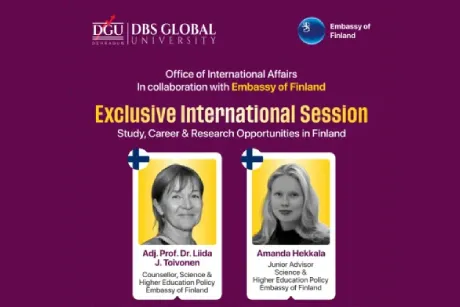
DBS Global University provides students with a wide range of opportunities to gain international exposure and enrich their academic journey through global learning experiences that combine international academics, industry exposure, and cross-cultural engagement. Through a strong network of 50+ academic partnerships across 20+ countries, the University offers multiple international pathways including Global Immersion Programs, Month Mobility Programs, Semester Abroad Programs with Credit Transfer, Articulation and Transfer Programs, Dual Degree Programs, and Global Progression Pathways. In addition to these mobility opportunities, students also benefit from international guest lectures, global masterclasses, academic bootcamps, and international events, delivered in collaboration with partner universities and global industry experts.